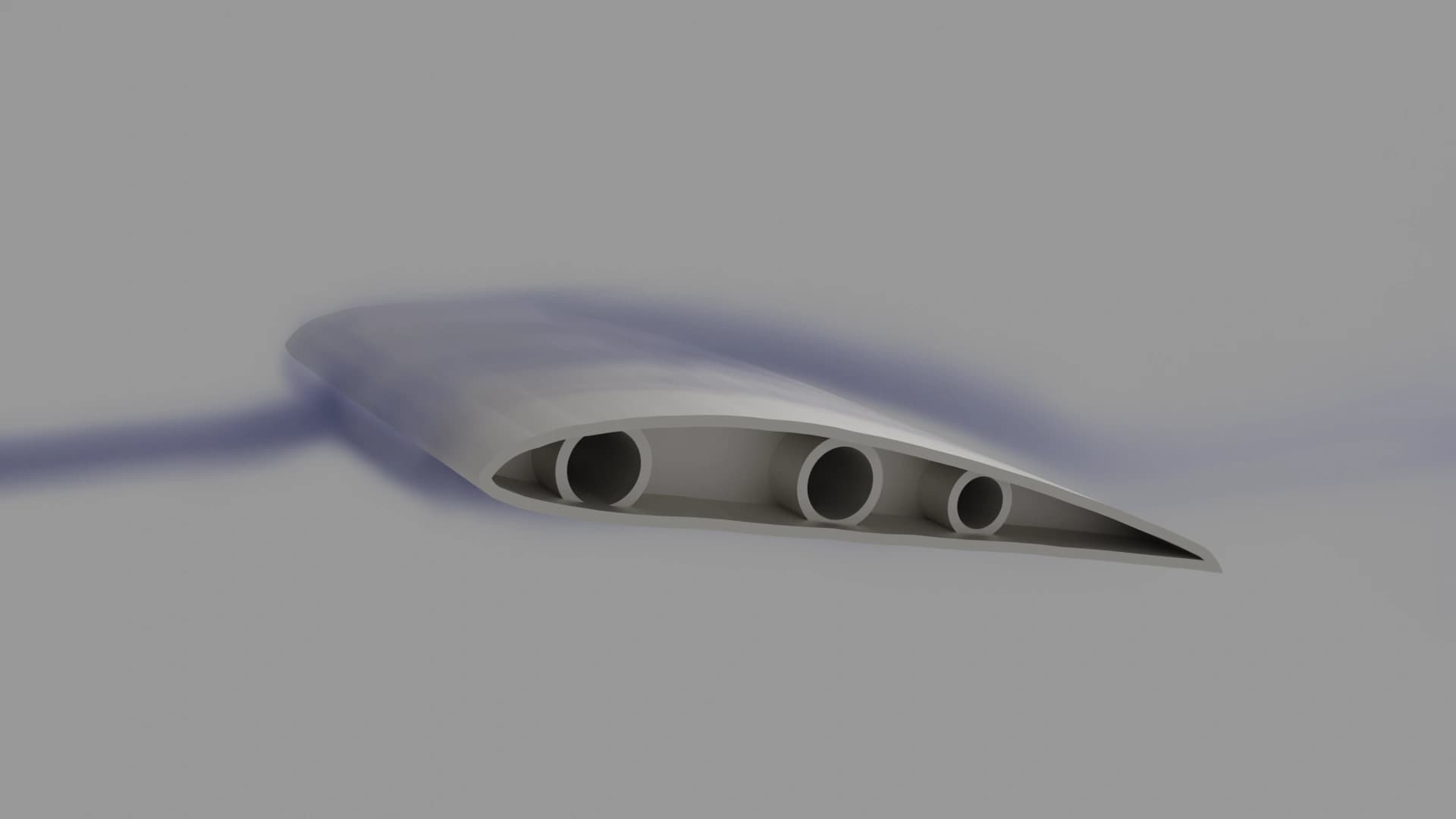
How an Airfoil Generates Lift: A Physical Explanation
Imagine looking up at the sky and noticing an airplane gliding smoothly overhead. The wings slice through the air with remarkable precision. Hidden with the wing's cross section is a carefully engineered geometric shape known as "Airfoil". Well, Why do we even need an engineered special shape?
When an object moves through air, the air pushes on it. If the forces are balanced, nothing lifts. So to make something rise, we need to create an imbalance of forces.
To create lift we need a force imbalance between the upper and lower surfaces. In fluids, forces arise due to pressure acting over an area(F=P×A). Therefore, a difference in force must come from a difference in pressure. This pressure difference is created due to differences in airflow velocity, which is explained by Bernoulli’s principle. The Bernoulli equation (for steady, incompressible, non-viscous flow along a streamline) is:
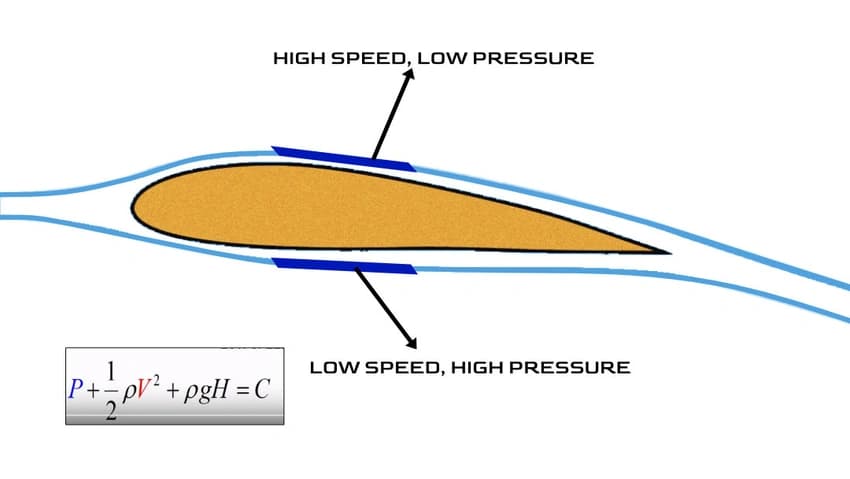 Figure 1: Cross sectional view of an airfoil. Reference: ResearchGate
 If air moves faster in one region and slower in another, the pressure changes.
Faster air → lower pressure
Slower air → higher pressure
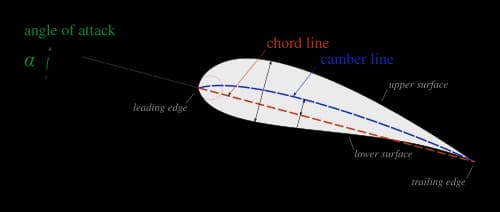 Figure 2: Geometry of an airfoil. Reference: Skill-Lync
 From Figure 2, a curved line named camber line can be clearly seen. The camber line is the curve that runs exactly midway between the upper and lower surfaces of the wing. Camber determines how much the wing bends upwards. Somewhere along the line this curve reaches its highest point, which is basically maximum camber. Camber makes the airfoil shape non-symmetric about the chord line (the straight line from leading edge to trailing edge of an airfoil). The upper surface is more curved than the lower surface. Flow cannot pass through the airfoil, so, streamline are forced to follow the curved shape. Because of the curved shape of the airfoil, air does not move the same way on both Figure 2: Geometry of an airfoil sides. As the upper surface is more curved, so the air has to move faster over it compared to the lower surface, where the flow is relatively slower. This difference in speed creates a difference in pressure without needing to repeat the full Bernoulli explanation. As a result, the pressure on the top becomes lower and the pressure on the bottom becomes higher. When all these small pressure differences are added over the whole surface of the airfoil, they create a single upward force. This overall force is what we call lift. That’s how camber creates lift. Now comes how camber creates lift in zero angle of attack. Angle of attack is the tilt of the wing relative to the incoming airflow. When a wing is tilted, it deflects air downward, and the reaction force from this change in momentum produces lift. However, even when the angle of attack is zero, a cambered airfoil can still generate lift because its curved shape naturally bends the airflow and creates an asymmetric velocity distribution. In this case, the geometry itself plays the role of “tilt,” allowing the wing to produce lift without being physically angled.
Having understood how camber introduces lift by creating an asymmetric flow field even at zero angle of attack, the picture is still not completely closed. Geometry explains why the flow tends to become unbalanced, but it does not fully explain how the airflow organizes itself in a physically consistent way, especially at the trailing edge of the airfoil.
A key geometric feature that enables this behavior is the sharp trailing edge of the airfoil. The trailing edge is intentionally made sharp so that the airflow cannot smoothly split and wrap around it from both sides at the same time. If the trailing edge were rounded, the flow could follow multiple possible paths, making the exit behavior ambiguous. The sharp edge removes this ambiguity and forces the fluid to select a single, stable way of leaving the airfoil.
This leads to a fundamental aerodynamic requirement known as the Kutta condition. The Kutta condition states that for a real, viscous fluid, the flow must leave the trailing edge smoothly and tangentially, without infinite velocity or backward curling around the edge. In simple terms, it is the physical rule that ensures the airflow behaves in a realistic and stable manner at the trailing edge. When an airfoil begins moving through air, there are many mathematically possible flow patterns around it. However, not all of them satisfy physical reality. The fluid naturally adjusts itself and selects the specific flow pattern that satisfies the Kutta condition. This adjustment is achieved through the development of circulation around the airfoil, which organizes the flow into a consistent rotational motion around the wing. Now the role of camber becomes crucial. A cambered airfoil already introduces asymmetry in the geometry, meaning the upper and lower surfaces influence the airflow differently. Because of this, the flow field is naturally biased even before any angle of attack is applied. As a result, the circulation required to satisfy the Kutta condition is no longer zero. Instead, the system naturally settles into a non-zero circulation state even at zero angle of attack.
This circulation is directly responsible for lift generation and is expressed by:
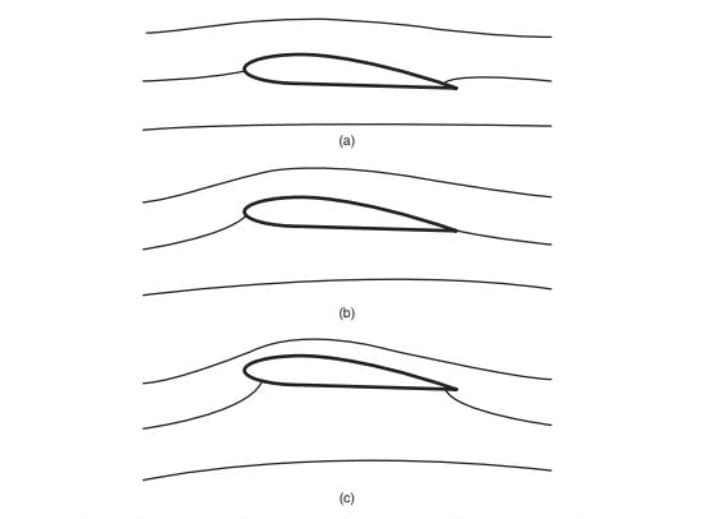 Figure 3: Sketches of potential-flow streamline patterns around the same airfoil shape with different values of circulation. (a) Zero circulation: Zero lift (b) Circulation such that flow leaves trailing edge smoothly; some lift (c) More circulation; higher lift than (b)
 Finally, the complete physical picture of lift generation can be understood as the interaction of all these elements:
Camber: which introduces geometric asymmetry and biases the flow
Angle of attack: which controls the strength of flow deflection
Sharp trailing edge: which enforces a unique and stable flow exit
Kutta condition: which selects the physically valid flow pattern Circulation, which emerges as the result of flow adjustment
Together, these factors transform a simple geometric shape into a lift-producing system. Lift is therefore not a single effect, but the result of geometry shaping the flow, and physical laws constraining how that flow must behave.